
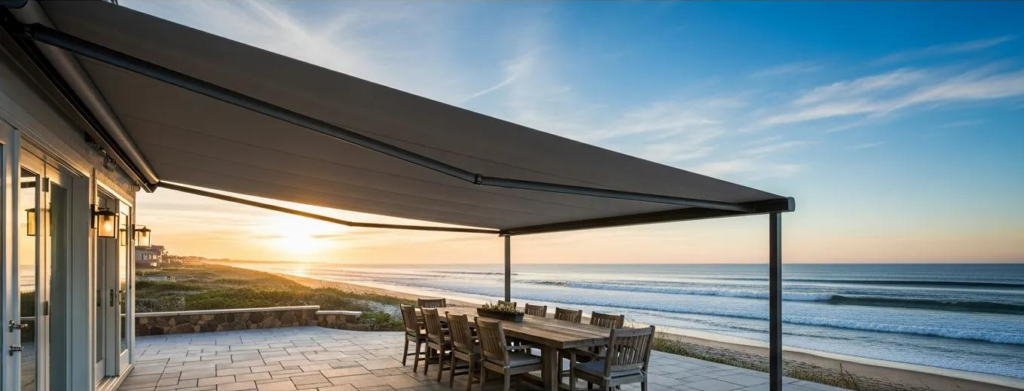
If you’ve been shopping for an awning and landed on this page, you’re probably staring at two very different options and wondering which one actually makes sense for where you live. Retractable awnings look sleek and flexible. Fixed awnings look solid and dependable. Both shade your patio but that’s about where the similarities end.
The choice gets even more specific when you’re on the Delmarva coast. Salt air, coastal storms, and high summer humidity put real stress on outdoor structures in a way most national buying guides simply don’t account for. Whether you’re in Rehoboth Beach, Ocean City, MD, or anywhere else across the Delmarva Peninsula and surrounding areas, the “right” awning isn’t just about aesthetics it’s about what’s going to hold up in your specific environment.
This guide breaks down the real differences between retractable and fixed awnings, what each one costs, how they perform in coastal conditions, and which scenarios each one is actually built for. By the end, you’ll know exactly which direction fits your home.
What Is the Difference Between a Retractable and Fixed Awning?
Before getting into which is better, it helps to understand what actually separates the two.
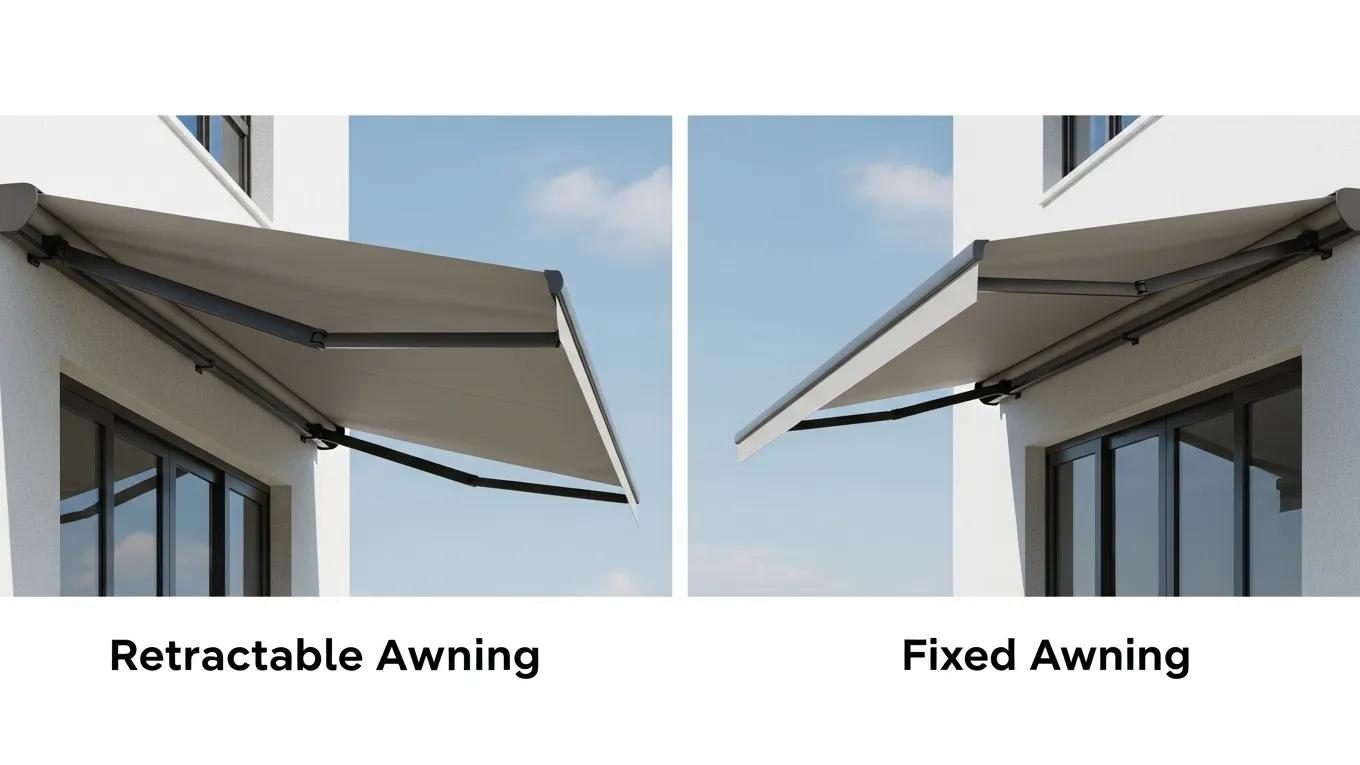
A fixed awning sometimes called a stationary awning is permanently attached to your home or structure and stays extended at all times. It doesn’t move, doesn’t retract, and doesn’t require any operation from you. It’s shade on demand, all the time, whether you want it or not.
A retractable awning extends and retracts on demand either manually with a hand crank or motorized with a remote or wall switch. When the weather’s perfect and you want full sun, you roll it in. When it’s beating down and you want shade, you extend it. Motorized retractable awnings can even include sensors that automatically retract the awning when wind speed hits a certain threshold a genuinely useful feature in coastal areas where afternoon gusts can arrive fast and without much warning.
Retractable Awnings: Pros and Cons for Coastal Homes
What Retractable Awnings Do Well
Flexibility is the core advantage. You’re not locked into shade when you want sun, or sun when you want shade. For homeowners who entertain outdoors, have a south-facing patio, or just like options, that flexibility is difficult to overstate.
Wind protection built in. A retractable awning that’s rolled in during a coastal storm is a retractable awning that isn’t getting damaged. For homes in Bethany Beach , or Ocean Pines, MD where fast-moving storms are a reality through late summer the ability to retract before a storm hits is a meaningful durability advantage over a fixed system.
Longer lifespan in coastal climates. Because the fabric and frame spend time protected rather than permanently exposed, retractable systems tend to hold up longer in salt-air environments than fixed awnings built from the same materials.
Motorized options add real convenience. Sun Air motorized retractable awnings which Coastline installs across Delaware, Maryland, and beyond can be operated from a remote, a wall switch, or even integrated with a smart home system. Wind sensors can trigger automatic retraction without you having to think about it.
Where Retractable Awnings Fall Short
Higher upfront cost. A quality retractable awning especially a motorized system costs more to purchase and install than a comparable fixed awning. The motor, the hardware, and the installation complexity all add to the price.
More moving parts. Any system with a motor and a mechanical retract mechanism has more components that can eventually need servicing. Quality brands like Sun Air minimize this, but it’s worth knowing.
Fixed Awnings: Pros and Cons for Coastal Homes
What Fixed Awnings Do Well
Lower initial cost. Fixed awnings are simpler to manufacture and install, which typically makes them the more budget-friendly entry point. If shade is the goal and flexibility isn’t a priority, a fixed awning delivers on that for less upfront.
Zero maintenance of moving parts. Nothing to retract, no motor to service. A well-installed fixed awning with quality materials is genuinely low-effort you clean the fabric periodically and that’s largely it.
Consistent coverage. If you have a specific area a storefront entry, a south-facing window, a spot that gets blasted by afternoon sun every single day a fixed awning solves that problem permanently without requiring you to remember to extend it.
Where Fixed Awnings Struggle on the Coast
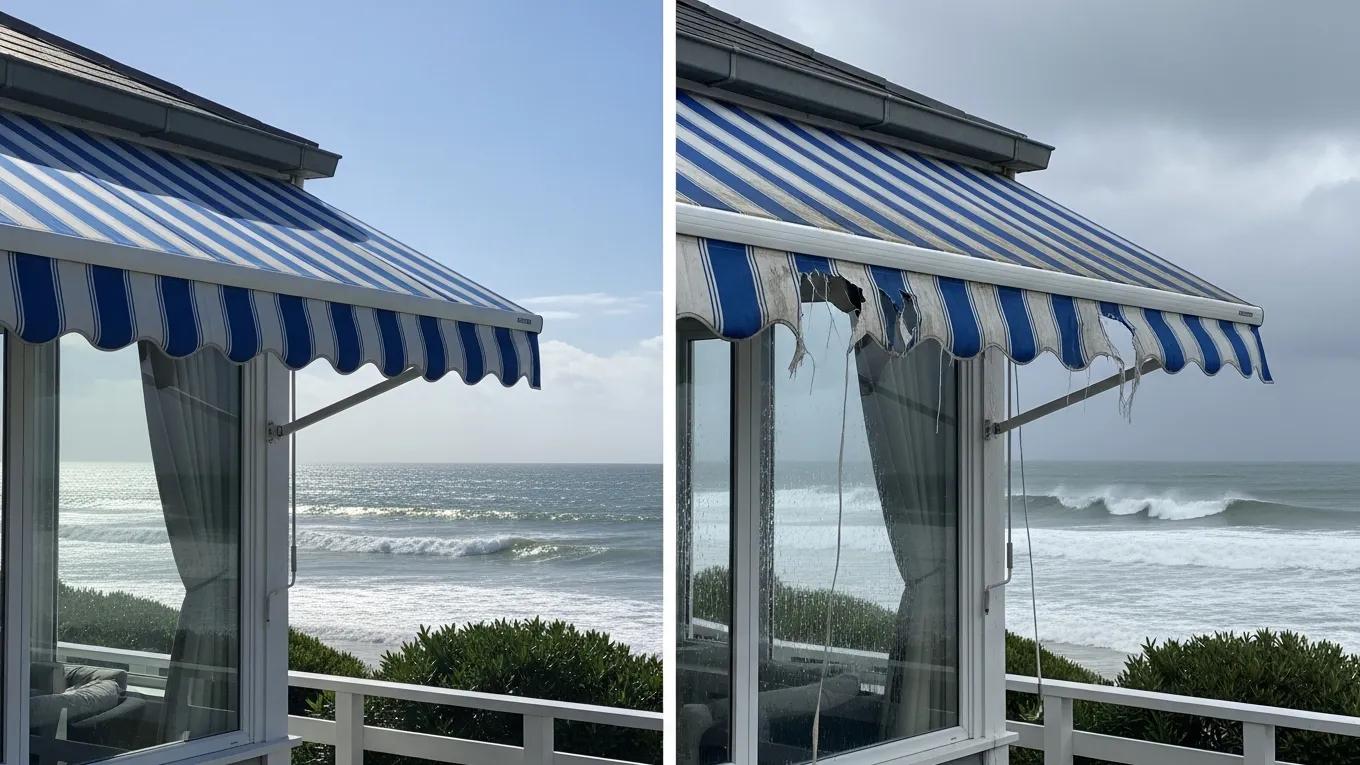
Constant exposure in a corrosive environment. Salt air doesn’t stop just because you’re not sitting outside. A fixed awning in Selbyville or Chincoteague, VA is exposed to coastal conditions 365 days a year which puts real pressure on frame finishes, fasteners, and fabric longevity compared to a system that can be retracted and protected when not in use.
Vulnerable during storms. A fixed awning can’t get out of the way of a fast-moving coastal storm. In areas like Berlin, MD, Ocean City, MD, or Millsboro where summer storm systems can roll in quickly off the water, a fixed awning is fully exposed every time which is why quality installation and material selection matter more here than anywhere else.
No flexibility. If you decide you want full sun for a few hours, a fixed awning doesn’t give you that option. What you get is what you get, all day every day.
Retractable vs. Fixed Awning Cost: What Should You Expect to Pay?
Cost is often what tips the decision, so here’s an honest breakdown of what you’re looking at on the Delmarva coast.
Fixed awnings typically run from around $500 to $3,000 installed, depending on size, fabric quality, and frame material. Commercial or larger residential installations can run higher.
Retractable awnings generally start around $1,500 and run to $5,000 or more installed, with motorized systems sitting toward the upper end of that range depending on size and brand. A Sun Air motorized system with wind sensor will cost more upfront than a basic manual retractable, but the longevity advantage in a coastal climate typically justifies the difference over a 5–10 year window.
These are general ranges your actual cost depends on your specific space, mounting situation, and the fabric and frame options you choose.
Which Is Right for Your Coastal Home?
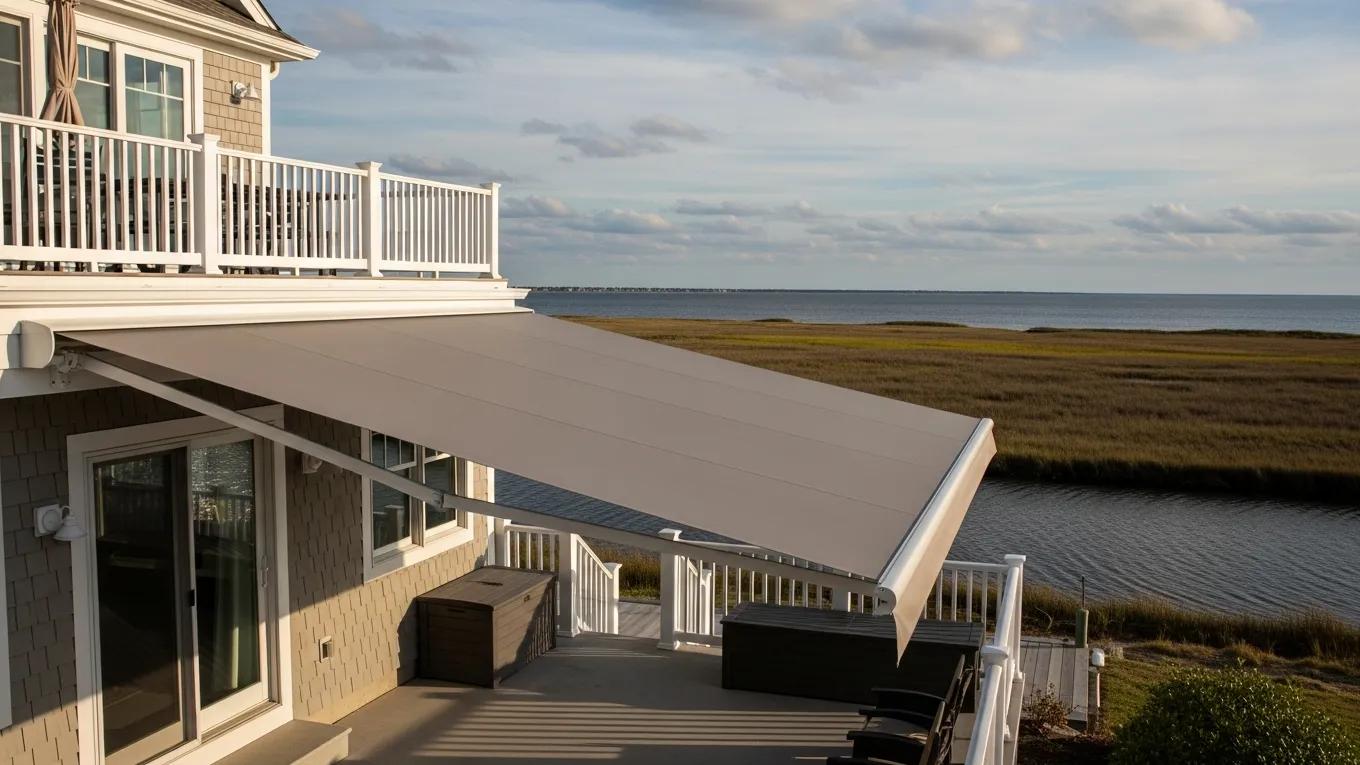
Here’s a straightforward way to think about it:
Choose a retractable awning if:
- You want flexibility between sun and shade depending on the day
- You live close to the water in Rehoboth Beach, Ocean View, Salisbury, MD or another exposed coastal location
- You want a motorized system that retracts automatically in high winds
- You’re thinking long-term and want an awning that holds up in salt air for years
Choose a fixed awning if:
- You have a specific shading need that’s consistent and predictable
- You’re working with a tighter upfront budget
- The location doesn’t get significant wind exposure
- You prefer a completely hands-off solution with no moving parts
For the majority of Delmarva homeowners we work with across Sussex County and beyond, the retractable option tends to be the better long-term investment but the right answer always comes down to your specific home, location, and how you actually use your outdoor space. If you’re looking for something more structural that doubles as a permanent outdoor room, it’s also worth exploring a custom pergola as an alternative or addition to your shade setup.
Frequently Asked Questions
Do retractable awnings hold up in coastal wind?
A quality retractable awning particularly a motorized system with a wind sensor handles coastal conditions very well, because it can retract before high winds cause damage. A fixed awning has no such protection, which is why material and installation quality matter especially for fixed systems in coastal areas.
What is the best awning material for salt air? Solution-dyed acrylic fabrics (like Sunbrella) are the gold standard for coastal environments the color and UV-resistance are baked into the fiber itself rather than applied as a coating, which means salt air and sun don’t fade or degrade it the way they would a coated fabric. Aluminum frames with a powder-coat finish resist rust significantly better than steel in a salt-air environment.
How long does a retractable awning last?
A quality retractable awning installed correctly typically lasts 10–15 years with normal maintenance. Coastal conditions can shorten that if the awning is left extended through storms repeatedly which is exactly why a motorized system with auto-retract is worth the investment in Delmarva’s climate.
Can I add a motorized retractable awning to my existing deck or patio?
In most cases, yes as long as there’s a suitable mounting surface (fascia board, exterior wall, or structural beam) and access to power nearby for a motorized system. A site visit is the only way to confirm what’s possible for your specific setup.
Is a fixed or retractable awning better for a storefront?
For commercial storefronts, fixed awnings are the more common choice because they provide consistent, always-on shade and branding without requiring staff to operate them. Retractable systems are generally better suited to residential patios and decks where flexibility matters.
Ready to Find the Right Awning for Your Home?
Whether you’re leaning retractable or fixed, the best next step is a free, no-obligation estimate from a team that knows coastal installations. Coastline Sunrooms & Awnings has been installing awnings across Selbyville, Bethany Beach , Ocean City, MD , and the wider Delmarva Peninsula for over 30 years and as an authorized Sun Air dealer, we carry systems specifically built for the coastal conditions you’re dealing with.
Call (443) 844-8194 or request your free estimate online today and let’s find the right awning for your space.